Guitar Chords Resource Page

Recent Articles

What Equipment Do I Need For An Acoustic Gig?


What Equipment Do I Need For An Acoustic Gig

Basic Equipment List You Will Need For Professional Acoustic Gigs Plus Tips

1   Acoustic Guitar With a Decent Pick Up

2   Powered Speakers x 2

3   Sound Mixer External Effects Such
as Reverb and Delay

4   Microphone For Vocals

5   Microphone Boom Stand

6   Speaker Stands For Powered Speakers

7   Microphone Lead’s, Guitar Lead’s, Speaker Leads

9   Guitar Strap

10   Capo

11   Guitar Tuner

12   Guitar Stool

13   Guitar Stand

Extras

14   Stomp Percussion Box

15   Looper Pedal

16   Subwoofer

17    Lights

18  Music Stand

19   Black Curtain’s for Tidying Stage

20   Miscelaneous Spares
Spare Strings, Wire Cutters,
Spare Batteries, Pickups , Spare
Picks, Gaffer Tape, Small Plyers

21 Bags for Equipment

22 Extra Spares Spare Guitar, Spare Microphone

23 Break Music

About This Article

All you need in theory for an acoustic gig, is guitar,mic,acoustic amp(with built in mixer and effects),mic and speaker stands,leads, and maybe a few lights. This setup will limit you to small rooms and restaraunts and see you doing gigs mainly as background music ….which is fine for those gigs. If you want to perform, entertain and address the audience in bigger than restaraunt size rooms ,and have backup to keep your professional show moving, you will need to look at this list in detail. Even if you are doing background gigs , use this list to top up your profesionalism to work towards bigger gigs.
This list is a basic equipment list you will need for profesional acoustic  gigs . I will go through this list with you to help you start gigging, and also clue you in on the essential extras you will need to make your show’s successful, and to keep the gig afloat , because the show must go on ! I want you to be able to avoid the simple things that can stop a gig in its tracks .

The PA system

A PA system is short for public address . All the equipment listed above  is basically a system that will allow people in a larger room to hear you play and sing clearly by amplifying your sound. The equipment you use and how you use it will determine how you sound to other people at your gigs. Take some time to understand what the equipment can do and learn how to use it the best you can . Its not as hard as you think.

I want to guide you on getting the right gear for a small/medium set up .

1 Acoustic Guitar With A Decent Pickup

My Cole Clark Acoustic Steel ..This Guitar Has Done Some Work  ! $1500
My Yamaha NCX-700 Flamenco Classical Nylon String $750

 Approx Cost Between $400-$3000 or Upwards

Good Brands Include: Maton , Cole Clark Yamaha, Martin , Takamine, Taylor, Guild Gibson

Ask Yourself These Questions With Your Guitar

1 What quality acoustic guitar do you have?

2 Is it in good condition for playing ?

3 Does it sound good before you even plug it in?
4 Has it been set up for correctly with its action?
5 Does it need adjusting.

These can be really simple things to fix. If your guitar is too cheap and hard to play you may be putting yourself at a disadvantage to start with .

Make sure your guitar doesn’t have anything simple wrong with it that will make it sound not as good as it could . If you are in doubt then seek some advice from a pro player. Remember this is one the central most important pieces of equipment of your gig , and soon it will be amplified by the PA and broadcast louder and clearer to the public , so you want your guitar to sound good within itself , as well as  when it is amplified,… right ! A little bit of good advice can save you a lot of hassle .

If it sounds good , has a decent pickup, feels good to play, then that’s great! You should just be able to plug it into a PA .

Guitar Pickup

Pickup Controls on Yamaha NCX-700
Pickup Controls On Cole Clark Acoustic


Your acoustic guitar will need to have a decent pick up in it . Most acoustic guitars with pickups these days are pretty good . Most decent brand of guitars will install these pickups ready to go . Pickup controls on the side of the guitar(as pictured) is a must!

Check with a music professional that your guitar pickup sounds decent through a PA system . Take it into a shop and ask to plug it in if you havent got speakers yet. . This is a great way to test out some powered speakers . Ask yourself how it feels when you play it through a PA system. Guitar pickups can vary quite a bit and it makes sense to play around with them and understand how they basically work to see if you can get a sound that feels good while you play. The more you feel good while you play, the more positive the experience that will translate into the audience feeling good while they listen .

2 Powered speakers
    

Mackie Thump TH-15A $750 EA  400Watts


Estimated Cost Between $300 ea to $2500 ea or upwards

Good Brands Include: Bose, JBL, Mackie, Yamaha

Powered speakers are speakers that have amplifiers built in to them . Powered speakers are definitely the best way to go .They are simpler, easier to set up, save space, and the range and quality of powered speakers these days is great. The alternative is to have separate amplifier and separate speakers which take longer to set up take up more space and generally weigh more.

It is best to have two at least powered speakers for your acoustic gig . One speaker will be used close to you, for you to monitor your sound and to hear your playing and singing clearly . The other will be used mainly for getting your sound louder out into the room for the audience . You can get by with one speaker , but your sound volume and sound spread will be compromised.

Decent powered speaker brands are : JBL,Mackie, Yamaha

How many Watts Do I Need For An Acoustic Gig With Powered Speakers?
This question is very open ended and could be the topic of a very long article in itself.

Lets look at it this way. How loud and clear do you want to be for any given venue?
If you are background music in a small room, one or two 200 watt speakers will sufice, ,even then you wont need to run them hard. In a bigger room you will need at least two 400 watt speakers to deliver a full sound that will present a musical performance in its fullness.. Even then you may need to add  a sub, which we will cover later. When I say in its fullness , I mean the full body of sound from low frequency warmth to clear high frequencies,

3 Sound Mixing Desk With Effects

Allen and Heath 12 Zed FX $950
The Built In Effects Section on The 12 Zed FX

Estimated Cost Between $170 to $2000 and Upwards

Good Brands Include: Allen and Heath , Mackie , Peavey , PreSonus

A mixing desk is a piece of equipment that will mix the sound of your guitar, vocal (and any other instruments that are plugged in) and blend effects like reverb and delay , mix all these sounds together to the right levels and send these sounds to the powered speakers . The actual levels and mixing settings will be set by you or someone else, probably you if you don’t have your own personal live sound engineer.

Having effects on these mixing desks is a must . The effects you will need are reverb and delay. Some desks don’t have effects but have provisions to add effects externally or auxiliary effects . This provision is known as auxiliary effects send and return . I highly recommend for musicians that are new to gigging, to buy themselves a sound mixing desk that has effects built-in . This will save you time set up and also save you confusion in how to run your effects . If you use of auxiliary effects it can work great, but you will have the extra set up time and fiddling to set the levels correct . If you are tech minded and don’t mind going the extra yards to seek out the exact type of effects you want for your vocal then that is cool . I actually do both , I have a small desk with built in effects for smaller gigs and a larger desk with no effects that I use other auxiliary effects to plug into the desk .

Not having any effects at all on vocal especially, can make for a really dry and dead listening experience, especially if the room is heavily carpeted or dead sounding to start with.

I was at a house party recently and there was a small acoustic group playing there .They were on a tour of the East coast, and did not have any effects on the desk whatsoever and didn’t seem to care. They sounded so dead and dry despite the fact they were all decent muso’s with good songs. Dont diminish your performance with no efeects, as many modern muso’s seem to do .

Effects when used in the right way can really make your sound sparkle . There is an simple important approach to reverb and effects .I have heard many performers use no effects and it is not very impressive .

I have also heard many performers use too much effect this can be equally as annoying . it just sounds like they are playing in a cave. there is a happy balance, but you definitely want the option to control the effect ambience off your sound in any room . Onboard effects on a mixing desk will give you this. It will also help you get into the vibe of the song performance when you set these levels right . If you are in the vibe, then so will the audience .

4 Microphone For Vocals

Shure SM-58 $140…done some miles this mic!


Estimated Cost Between $99 to $700
Good Brands Include: Shure Sennheiser, Audix, Beyer

You will need a decent quality microphone to sing through . don’t buy some karaoke El cheapo toy thing and hope that it is ok . Great all rounders mics for vocalist’s live are:
Shure SM58 $99

Shure Beta 58A $ 159

Sennheiser e835 $99

Audix OM3 $130

Shure Beta 87A $249

I am using the good old standard Shure  SM58  for live sound . I can’t remember how many times I have  dropped these mics and they still work .

Remember all microphones have a different flavour of sound, and all voices are different! To put it another way , you can have dark mic’s and bright mics. Also you can have bright sounding voices and mellow(or dark) sounding voices.

5 Microphone Boom Stand

Approx Cost Between $70 to $200
Good Brands Include: Tama, Hercules ,K&M

Microphone Boom Stand (not straight up and down)

 You will need a boom stand for your microphone . The boom will allow you to position the microphone to a comfortable position whether you are sitting or standing . A standard straight up and down mic stand will not cut it for gigging when playing the guitar , You will not get comfortable and it will be awkward to get to the microphone properly. Get a decent solid boom stand. Unless you don’t play guitar and plan on dancing round the stage with a straight up and down mic stand like Rod Stewart (an old stone age rocker ) , you will need a boom micstand.

6   Speaker Stands For Powered Speakers

Aluminium Stand $50

Approx Cost Between $40 and $100 ea


Speaker On Stand

 Good Brands Include: Hamiton

You will need adjustable stands for your powered speakers . Make sure the speaker stands are strong enough for your speakers . Most lightweight aluminum stands for speakers are good . Don’t use thin flimsy lighting stands and make sure the base opens up enough so your speakers don’t fall over on anyone or anything . Light weight but strong aluminum stands that are meant for speakers are the way to go . Getting the speaker’s up over the heads of listeners is crucial if you want people to understand the words you are singing and speaking. If the speakers are on the ground your vocals and entire sound will be muddy muffled and extremely compromised.  Powered speakers have woofers and tweeters , or low frequency driver( woofer) and high frequency driver( tweeter) If the tweeters are not above the head-height of your audience your sound will not be as clear as it should. Your vocals will be hard to understand . This can be the difference to connecting to your audience or not connecting .If people cannot understand what you are saying or singing ,..they will tune out …period. You want people to understand your vocals while you are singing, and while you are talking to them .

7 Microphone Leads, Guitar Leads, Speaker Leads

6.5mm Guitar Plug

A guitar lead has a 6.5mm plug on it and looks like this
Approx Cost between $20 to $50 ea

6.5mm Guitar Jack

 Good Brands Of Guitar Leads Include:Ernie Ball, Mogami Gold, Pig Hod ,Amboz Red Dragon,Fender,Lynx Pro , MonoPrice Premier,Vitrius Cables Silverback Roar

Microphone Leads are also called XLR leads and looks like this .

xlr Female
xlr male

You will need spares of both of these leads when you gig . Always carry the right spares, you will not regret it . At some stage your leads will fail you. Don’t be the chumpy faced amateur that has to finish up the gig early because of something as simple as a dud mic or guitar lead.

Speaker Leads

Most powered speakers will use XLR cables (leads) to run from the sound mix desk to the powered speakers. These leads are exactly the same as microphone leads and 90%of the time are wired the same way. It’s always a good idea to check the manual of your sound mixer to make sure the cables you use to run to your speakers are wired the same as a microphone cable. This is very standard these days. For this reason try and select a sound mixer with XLR outs. this also means that your sound mixer is sending balanced out to your speakers. Have at least 1 longer speaker lead so you will have an option to move your main speaker into the best spot for the audience, because venue size will vary.

8 Guitar Strap

Good Quality Wide Leather Strap

Approx Cost Between $20 to $80

Good Brands Include :Fender ,Di Marzio,Calvary Straps ,Planet Waves,….and any good custom strap maker

Guitarists must have decent guitar straps to play live whether they are sitting or standing . It is amazing how much difference having a quality strap makes!

If you have mostly played at home and you are now wanting to gig, adding a guitar strap will keep everything steady for you even if you are sitting . It will keep the guitar at the right level for comfortable playing . I recommend strap locks as well .

This pic shows my leather strap on my acoustic. A wide strap is good because it spreads the weight across your back and shoulder, which makes it comfortable and easy to balance the guitar while playing. This is especially good if you are playing an electric or bass when standing,…stops the weight from cutting into your back after long periods of time which means you can play longer .

9 Strap Locks
Aprox Cost $10 to $25

Good Brands Include: Fender , Dunlop, Schaller

These clip devices attach to your guitar strap and lock on to your guitar so it won’t fall in the middle of a song and smash down to the ground damage your guitar paintwork or guitar neck. This has happened to me a number of times while gigging! I still have the guitar scars to prove it .These locks also allow you to move around more without worrying so much about the guitar falling . Just about every muso I know has gone through this. Save some grief and spend 20 bucks and get them!

10 Capo`

Classical Nylon(black) and Steel acoustic (silver) capos…notice the classical capo is straight while the acoustic steel capo is slightly curved to match the necks


Estimated cost aprox $15 to $30
Good Brands Include: Kyser, Di Adario, Nordic Essentials, Shubb


A capo is a device that allows you to change key of any song by raising the position of the nut to the desired fret.

Every acoustic guitarist should have one they bring a change of flavour to the sound instantly.

A good quality capo is that is quick to use and has enough tension to do the job is a must . Some El cheapo capo’s are not strong enough to press the strings down hard enough with even tension to make your chords sound clean . Don’t even bother with the elastic clip on type, they are dumb and will waste time on stage in between songs.

Capo’s give the audience a break from the standard open chord sound, making it more interesting for the listener. Carry a spare Capo as well… Capos can break!

11 Guitar Tuner


Approx cost between $15-$100
Good Brands Include: Korg , D’Addario, Boss , TC Electronics,


A clip on guitar tuner is a must , I have one on each guitar live when I play. These are a cheap item to purchase ($15) and work really well for a quick tune up in between songs.
Make sure you can calibrate your tuner , which means fine tune for example most tuners are at a standard of a= 440htz,…some people like myself will calibrate a=432htz, which is a tad lower than standardized pitch.
I do have a more expensive guitar tuners that I use for guitar technical adjustments but, for playing live these clip on tuners work great ! A clip on tuner that attaches to the headstock like in this photo, and is great because all you have to do in between songs is turn your guitar volume down and then tune up. You don’t have to unplug or bend down etc . This saves time and keeps the flow of the show.

12 Guitar stand

Guitar Stand $15

Approx $10 to $30

Good Brands Include:

Your guitar on a stand helps keep your guitar out of the way on stage an it looks great. It’s on display waiting for you to play it , rather than in its case where no one can see it and where you can trip over it . The small fold up type take up very little space add help tidy up your stage.

13 Guitar stool

Will you be sitting or standing or a bit of both? If you are sitting on a stool it is best to have the same stool to sit on every time you play, otherwise if you rely on finding one at the venue, it maybe a completely different height which would change playing style and the way you actually play . The same stool helps you to be more consistent with your playing.

There are all sorts of fold up stools .Get yourself a sturdy one .

Extras

14  Stomp Percussion Box

Approx $100 to $300
Good Brands Include: Wazinator ,Puckn Stomper,Log Jam Logarhythm, Roland SPD-1K

A Stomp box is a percussion foot device that adds beat to your playing . It is also one of the top two pedals that I recommend a guitarist own.

These boxes are a great way great for adding beat to your acoustic shows .They help drive a song and give it more life, and get people’s feet tapping as well as encouraging them to dance . It is also great for your own internal rhythm.

Like most guitarist’s I hesitated for years before using one at my acoustic gigs because I wasn’t confident I could use it properly . I have a lot to say on this topic , check this article out article here on “8 reasons a Stomp inbox improve your rhythm playing” I swear by these boxes a number of reasons, not just because they sound good at gigs but because  a stomp percusion box give you a deep connection to your internal rhythm .

15 Looper Pedal

Aprox Cost:$100 – $1000

Good Brands Include:

A looper pedal is in my top two pedals that a guitarist should own .A looper pedal is a device that allows you to play, record and instantly playback along with your own playing . They can be used to spice up the show and let you loose on some lead playing , which lets you add guitar harmony and different voicings on guitar. They are also a great songwriting recording tool for home , by allowing you to lay down ideas quickly and simply.

16 Subwoofer

Approx $500to $1000
Good Brands Include: JBL, Mackie, Yamaha, Bose
You wont always need a sub some venues it will definitely be overkill but some bigger venues you may require some punch down low to fill the room .

A subwoofer is an extra powered speaker you could add to your Pa to give it extra bottom end low frequencies or extra oooomf .Technically it is adding low frequencies to your sound generally between 30-100hz. A subwoofer will give your overall sound more warmth and punch! If you are using a stomper it will drive this aspect of your sound more also . Your acoustic guitar will sound a bit fuller as well .

17 Lights

Approx Cost Between $50-$500 for a small setup

Good Brands Include:

If you are going to be playing at nightime you will need some lights , otherwise you will be relying on the house lights which may or may not be adequate. There is nothing worse than listening to good music under a bank of static fluro’s. It kills the mood and wont do you any favours with helping you connect with your audience in any way. I prefer reds and yellows and even some uv these days ,…seems to feel much better for the audience as well .

18 Music Stand page Turner or iPad

Some gigs it is acceptable for you to have a music Stand or iPad in front of you . Restaurants beer gardens background music for dinner music at weddings not a prob . Other performances it is not. A song is delivered differently when the musician knows if off by heart rather than reading it from a written source . If you’re doing a showcase gig at a festival ask yourself how it might look to the audience if they see you reading your words or chords . If you cant be bothered to learn your words or chords for an important showcase gig what the hell are you doing there? If you want a song to really kick ass then learn it and, get it under your skin so you can deliver it with feeling and conviction .

Think of it this way …If you are delivering a performance that you want people to watch, do you want them to watch you reading music?

19 Black Curtains For Tidying Stage

Approx Cost $30-$100

Some things on stage will need to be covered or tidied up .A few small black curtains are just the ticket. Stage presentation is important . Don’t make the stage like a messy bedroom. Be neat.

20 Miscelaneous Spares

Spare Strings
Approx $10 to $20 per pack of six
Good Brands Include: Elixer, D’Addario, Augustine

My Acoustic Steel Strings
My Classical Strings


You will break strings at gigs . this will probably happen do I in the middle of your best song when you least expect it, but don’t worry ,…you have spare strings, better still you might even have a spare guitar. Carry at least couple of sets off spare strings every gig .

Wire Cutters Screwdrivers and Torch

Wire Cutters ,Plyer’s, Screwdrivers , Head Torch


Wire cutters come in handy for snipping strings after string changes ,so you don’t poke your eye out or a fellow muso! Screwdrivers come in handy for anything you have to take apart to try to get you through the gig . A torch is handy because stages can get dark .

21 Bags For Equipment

Approx Cost $15-$30 ea
You will want decent easy access zip or clip lightweight bags for putting leads and accessories in, preferably black. Bright coloured bags will look weird onstage trust me . Often there is nowhere but the stage area to store the bags once you have set up, black blends in way better than brighter colours, and keeps your equipment organised and neat.

22 Extra Spares
Spare Guitar Spare Mic

Spare Guitar

I personally always have at least two guitars at a gig . If I break a string I can always pick up my second guitar so the show never stops . This may not be an option for everybody , in which case you need to be an expert in quick string change’s.

Spare Mic
It is very rare that a mic will die on you (especially a Shure SM58) but it can happen. A spare mic takes up very little space and will give you peace of mind. I sometime jam with other musos and carry one for that purpose as well.

23 Break Music
This is a no brainer . Its up to you to bring your own music to play in your breaks. Have your music player sorted and the leads and connections as well . Most Mp3 player will have a stereo 3.5mm jack out , this will typically plug into a 6.5mm stereo input or RCA stereo input. If you are using a Samsung phone the output will be 3.5mm also . If you have an iphone you will have to get a lightning adaptor as well .

Beginners Guitar Lesson 1


Welcome to your first guitar lesson. This lesson will be a step by step guide for anyone that wants to learn the guitar and has never played before.
First thing to do is to tune the guitar. We will tune to A = 440HZ  which is standard tuning.
If you don’t have a tuner you can use this link here

https://tuner-online.com/
Ok so now we are in tune , next lets learn the basics.


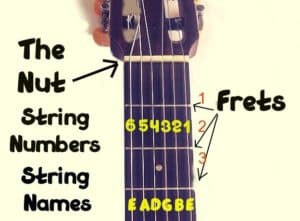
Learn    1  The String Numbers
               2   String Names
               3   Fret Numbers
               4   Left Hand Finger Numbers
               5   Right Hand Finger Names

How To Hold A Pick

Check out the right way to hold a pick, and don’t worry if you don’t want to use one, you can strum with your thumb. But give it a try , ..its good to be able to do both.

These chords are intro chords only , you wont need them in the future They are designed to get you playing fast and also to introduce you to the full versions later on .If you find this intro stuff too easy , don’t worry , it will get more involved I promise.


So you will notice on the chord charts not to play strings 5 and 6 for all three intro chords G,G7 and C .
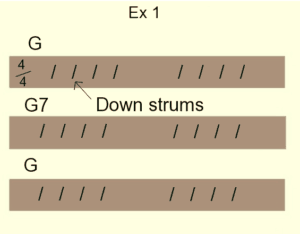
Each diagonal line represents one down strum.
Each chunk of four strums represents one bar , which in this case is one bar of 4/4 timing.
4/4 timing means there are 4 beats to every bar .

First Chord Easy G
Slowly strum strings 4321 on easy G with down strums and position your third finger as in the picture. Notice I am using pretty much the tip of my third finger. Also I am only using the amount of pressure needed to make the chord clear.

  
Keep it simple slow and steady and in two lots of 4 with no pauses in between. Enjoy the sound you are making,…you are making music , allow yourself to feel good about this! This is fun huh,…lets go to the next chord.
Easy G7 
 

Now with your first finger go to the easy G7 , same deal two lots of G7 using your first finger positioning like the photo .
Ex 1
 Strum this exercise with no pauses even on changing to G7 and back to G.

     Easy C Chord
This chord involves two fingers and you will quickly realize that the angle of how your fingers are placed is important.see photo .
   

Exercise 2
Now we add the Easy C chord to the mix . Same as Ex 1 only there is a C chord on the 3rd line .This is where you will notice things slow down a bit during changes , work on not stopping your right hand strumming to keep your changes smooth .This wont seem like a big deal at the moment but it will become huge when you start to increase your chord repertoire .For this reason I have written a whole article on it .
How To Make Your Guitar Chord Changes Clear And Smooth  link here
https://goodguitarsense.com/index.php/2020/02/26/640/


The name of the game is to keep your right hand moving ,….don’t stop no matter what even if your left hand is not quite in position yet ,…trust me….it will catch up !

Exercise 3  The Sun
Now we get into the real chords , Em or E minor as it is pronounced.
  Give it a strum use the fingertips arch so they don’t touch other strings and strum all the strings .  Nice sounding chord hey!

Now we introduce the bar line to all the exercises and songs . Think of the space between the bar lines as the bar . There are 4 beats to every bar in this song , the time signature of 4/4 tells us this , and for now the actual beats are written as diagonal lines .

Open Chords, Bar Chords, Scales… Great Resource Page !


Intro

This page is a resource page for open chords, bar chords and scales.
It also serves to give you a unique understanding of moveable chord positions and scales
and how they relate to each other.   This will give you a fundamental  understanding of guitar.…it will help you make sense of this instrument which is not laid out logically, and I aim to help you understand it !
     In the chord section you will notice there are some different versions of the same chord, for example there are two different G chords with different actual strings played . And sometimes there are the same chords played with different fingers used.
This is because sometimes  songs will use different versions of chords , and often peoples hands prefer slightly alternate hand positions to play the same chords .
Also it is worth noting that the pictures will help you visualize what the chord should generally look like from a players point of view. Notice the finger positions within the frets change from chord to chord. This is good for you to see so you don’t get hung up on this perfectionist static idea of how a chord should be fretted. A lot of teachers can get hung up on this too.Chords look less than perfect when they are played , every ones chords will look slightly different because we all have different hands which means there are different ways to fret and grip for individuals.


How To Hold A Pick


Basic Open Chords
x  means don’t play

0 means open string
Numbers below chord charts are the finger numbers used


Bar Chords

Its Not A Good Idea To Have A Ring On Your Chord Hand …..This Is Not Me!

First Position Bar Chords

The first position chords root note , and name of the chord is derived from the position (or fret ) that your first finger (or index finger) is playing on the sixth string.
  For example if your first finger is on the 3rd fret while playing a Major shape , the chord would be     G Major
Another example would be if your first finger is on the 6th fret and you are playing a Seventh shape , the chord would be Bb7 or A#7. It can be called both,

                     Continue reading “Open Chords, Bar Chords, Scales… Great Resource Page !”

How To Not Quit The Guitar and Overcome The Common Reasons For Quitting


People Quit The Guitar Because Of The Following Reasons, And All These Reasons Have Solutions Below If You Want To Play


1  Sore Fingers
2  Their Guitar Is Setup Wrong
3  Frustration At Their Progress
4  Frustration At Their Sound
5  No Direction
6  No Inspiration
7  Self Criticism,
8  Outside Criticism
9   Cant Relax
10 Not Learning The Music They Want,
11  Not Having Fun While Learning 
12 Not Practicing
13  Learning From A Teaching Source That Is   Sub Optimal
14  Their Guitar Is Always Packed Away
15  They Think They Are Too Old


1  Learn How To Overcome Finger Soreness

An amazing number of people quit the guitar because their fingers get sore . I honestly underestimated and overlooked the details of this phenomenon for years even when I was teaching . This led me to write a whole detailed article on see below . There are ways around soreness , many myths and way more methods to manage this barrier than you think .

Solution
Read This Article

“How To Overcome Finger Pain When Playing The Guitar Best Tips”
full article here
https://goodguitarsense.com/index.php/2020/02/26/642/

The main considerations of finger soreness when playing the guitar are to :

1 Evaluate Your Finger Tip Softness In Relation To What You Do Daily, So You Are Aware Of The Level Of Fingertip Hardness You Are Starting With

2 Realize Extreme Callous Building Is A Myth

3 Make Sure Your Guitar Action Is Setup Correctly

4 Make Sure You Have The Best String Gauge For Your Playing

5  Different Types Of Guitars Are Easier To Play Than Others

6 Fret Only As Hard As You Need To To Get The Chords Or Notes Clear

7 Regulate Fretting Hand Pressure With Smart Practice Routine To Reduce Soreness

8 Avoid Fingertip Bruising At All Cost

9 Cut Fretting Hand Nails To Correct Length

10 Don’t Chew Your Fingertips And Nails

11 Avoid Soaking In Water Before Playing

read this full article here “How To Overcome Finger Pain When Playing The Guitar Best Tips” http://”How To Overcome Finger Pain When Playing The Guitar Best Tips” full article here

2  Their Guitar is Setup Wrong

Solution

Get some advice , as a beginner its hard to tell where your guitar is at!
Play other peoples guitars , get an idea on what a good guitar is . Ask an experienced player to look at your guitar
to see if it is set up correctly for playing .What they are checking for is that your guitar string height action is where it should be to play comfortably. Any seasoned player will know right away if your guitar is setup correctly for learning and playing.

A lot of good players are really handy at setting guitar action themselves, others are not, but most will know where to send you. This will typically cost between$15 and $50 to fix. Try your local music store or ring the nearest guitar luthier (qualified guitar repairer technician ).

Acoustic Nylon..The Nut Set Too High 1…Wrong = Pain
View 1 Acoustic Nylon Strings The Nut Height Correct= No Pain

There’s only a tiny difference and its hard to tell,  that’s why you need someone to check it out for you .

In these two pictures guitar pic 1 is typical of a guitar that is not set up correctly at the nut. This is a common cause of finger pain . The distance between between strings and fretboard is too high , this will cause cutting into the fingers with the strings , because the player will be pressing too hard to get the strings clear …. = PAIN .

The other aspect of guitar setup to consider is the distance of the strings to the fret board towards the bridge end of the guitar , again here are two photos, one correct, and one not correct. There is a relation between distance all the way along the neck that makes it best to play and it’s good idea to get an experienced guitar tech or player to advise you on what to do. Trust me its easy to mess up when you don’t know what you are doing. Get some advice on the guitar you are playing.

More details and pics on this here :https://goodguitarsense.com/index.php/2020/02/26/642/

 3 Don’t Get Frustrated At Your Progress

If Your Ever Looks Like This Then It Means You Have Done Something Wrong…… Read On…..

Playing Guitar Seems Harder Than Most People Think At The Start …But Don’t WorryLearning the guitar is not instant, it is not an app. It takes time
Frustration cannot be any sort of ongoing part of learning any instrument. Remember this and you will be less likely to quit.

If you are getting frustrated, it obviously means something is wrong,

Its Either/Or A  Faulty Combination Of :

1 Mind Approach

2 Technique

3 Equipment Guitar Setup Wrong

4 Impatience

Solution
Push Through The Barrier Of “Gee I Dont Seem To Be Making Very Many Nice Sounds”  This wont take very long if you stick with it .
Focus On Beginning To Eventually Make Nice Sound’s With Basic Chords,
Focus On Your Progress Of What Is Sounding Good Rather Than The Imperfections In Your Playing
Practice patience through being relaxed

 4  Learn To Like The Sounds You Are Making Right From The Start

The First Stage To Get Through Is To Make Basic Chords/And Riffs Sound Good


People often get frustrated when starting the guitar, because it can take some time to make anything that sounds musical to begin with.

Guitar is different to a lot of instruments to play initially . If you press a piano key you can get a nice sounding note right away. Not so with guitar, there is more specific effort involved. Hand pressure has to be correct, fingers at the right angle, in the right position on the fret board, etc etc .
This is a double edged sword , and works in your favor later when you do get some basic skills , because it can be a a really expressive instrument because of the extra technique needed .

See look how happy These Two Are , They Got Past The Early Stages Of Learning And Now They Can Play Guitar Into The Sunset

Solution

Be Patient,  Learn To Like The sounds You Make Even At The Start. Every clear chord is a victory and something to be enjoyed . Focus on letting yourself enjoy the good parts as you learn., rather than waiting until you can play a full song. You would be astounded at how many people do this!
Learn The Right Techniques from a good source To Make Your Guitar Playing Sound The Way It Should.

  5 Have A Direction With Your Learning

Sometimes people learn an instrument aimlessly, and have no idea what type of music or songs they want to learn . Sometimes they don’t even care . I think it is good to care about this . It will help give you direction .

Solution

Know where you are headed and having some idea of the music and style you are wanting to play is important . If you have no idea then the teacher is likely to show you what methods and songs they think you should be playing . Or they might ignore you and show you their direction for you instead. Make sure you can identify some guitar styles and songs /riffs you wish to play. Have this on hand to show your teacher or use this in your search for internet songs .

6 Find Inspiration In Learning New Things

Solution

Look for inspiration in , new songs , in your own playing. Listening and connect to the good of what you are doing. Feel your own good energy while you play. Focus on the parts of your playing that sound good and build on this within yourself . This is focus. This also relates to self criticism that I spoke of earlier.Feeling good about your own progress will inspire you . All these points of this article interrelate to continuing and not quitting .

7 Don’t  Criticize Yourself Harshly

These next two points that relate to self and outside criticism are biggies . Criticism is an embedded fear deep in the subconscious of most adults and is a huge mind block of literally hundreds of people I observed when I was teaching.The harsh scolding voice of self criticism is a thing you need to banish, and practice banishing from your learning, if you want to progress.
You can use these methods in your guitar learning and then apply them to whatever other new  activity in your life that you want to learn . It works

Solution
When you catch yourself being critical , you need to nip this voice in the bud at that very moment by replacing the criticism with an encouraging constructive dialogue to yourself.
You literally have stop pause and reprogram yourself. This works extremely well. But it takes time and is part of your instrument learning training.

lets say it again” Quietening the voice of criticism in your mind takes time  takes time and is part of your instrument learning training”.
Yes this is a practice technique  !You can even speak the words aloud to help your mind to change its thinking. Just be careful ,if people see you talking to yourself all the time you may end up in a special place in a special jacket.
Words have energy and speaking words that change a positive to a negative thought can be a great way to reprogram, it works but it takes time .

Self criticism is huge is something a lot of people will have work on over and over and over but it will be one of the most important things to keep an eye on with your learning and playing. There is also lots of great advice out there from professionals to help you reset your mind.

You play guitar with your mind first. Most adults are extremely critical of themselves. Not having a harsh criticizing voice, or being in control of that voice coming from yourself, will definitely help you not to quit.

A major part of your practice will always be don’t be too critical on yourself with your progress. Always encourage yourself. Remember you are your main teacher. I found out that encouragement always had to be the main ingredient for music teaching to work. Which was surprising.

What does that tell you about the human condition?

8 Block Getting  Unnecessary Criticism By Others 

 Constructive criticism is OK and people can mean really well sometimes, but this is not what we are talking about here.If you are starting an instrument , you should be encouraged period. What I’m talking about here is the narkey unnecessary stuff. Same deal as above , but this time the criticism comes from outside . More often than not it’s from people close. And it is the harsh sneery tones that really affect people to the point of giving up. This is not how we are built to learn We learn all new tasks by failing stumbling and relearning. Do we need someone on the sidelines s telling us we are not very good and offering no encouragement. This is what some people do though.The things that people say can be off handed, double edged, or purely narcissistic.

Human beings are very sensitive to criticism. Every type of person ,every culture. Often it can be a one off comment from someone close that can stop people from taking a road in life that might really benefit them. With the learning of an instrument it can stop the process dead in it’s tracks…the good old power of suggestion! Now lets turn this around.

Solution

If someone tells you that you aren’t that good on guitar, know that their opinion is irrelevant. Even better, tell them its irrelevant. Be arrogant in your own determination to learn the guitar, and don’t let any “energy vampire’s” comments stop you from continuing. Express this to them in any way you want, or disregard their criticism and stop playing guitar in front of them all together in the future.

It doesn’t matter what guitar playing level you are at. If it is constructive criticism, it is OK when is it comes from the right place, and the tone and intent is helpful. If it is not constructive, do not stand for it or listen to it in the future . Replace their criticism with encouragement to yourself. Remove this activity from their space.

Do not tolerate narcissistic toned people and do not let their worthless jaded opinion affect the fact you want to play this instrument. They are putting you down to make themselves feel better.

My Learning Experience
When I was fifteen one of my best friends told me one day with a sneer “You can’t sing, you haven’t got a good voice.” , no his name wasn’t Simon….This was one of the many put downs from this mate, with his criticism of my music,  I decided then and there to stop hanging around him , because music was something I really wanted to pursue in my life, no matter what, and I couldn’t listen to his constant cynicism and putdowns anymore.  Don’ listen  to narcissistic comments from others especially those close to you.
With my music at that age I was pretty bullheaded , and I understand as you get older it can be harder, because I have been affected more as an adult with this type of behavior than I seemed to have been as a teenager.
Adults are extremely self conscious when it comes to learning the guitar.

Let me say this, talent is no substitute for persistence, I have seen over and over persistent individuals overtake more naturally talented players again and again. Be persistent my friend. Don’t listen to the narcs, they don’t count for anything. Don’t let stop them you doing anything you want to do, especially loving playing music.

You can deflect it. Shields up, push on.

9 Learn To Relax

Learn to relax while playing the guitar by switching off all tech, phones TVs and choose a time to practice when you will have the least amount of distractions. Practice getting into the most effortless state of concentration you can.

Playing Guitar Outside With No Distractions Is A Great Way To Relax…And Practice

When you feel any sort of tension, overt muscle tightness or anxiety, nip it in the bud take a deep breath do some stretches and relax .

Stress is not a great way to practice anything well. Proper preparation for relaxation is taking care of all the above points. Try playing in a park or by a river . Outdoors is my favorite place to play acoustic. Outdoor gigs are my favorite as well.

10 Learn From Someone That Will Show You What You Want To Play

If you are learning the guitar and your teacher refuses to show you  some styles of playing or songs you want to learn , you need to question your teaching source. Ask to be shown something that related to your musical taste early on in being taught , if this doesn’t happen….

Solution

Get a different teacher . If the teacher consistently ignores any request to teach you something, anything you want to learn ,…even from the beginning , you need to get another teacher. When I was teaching music , depending on the student, I would be looking for riffs bits of music, songs to teach that would light up the students interest to play. This was a key part of my teaching, it is essential to have this in the mix when you learn. You tube can work well for this there a a million song tutorials on how to play specific songs, use these and get the good guidance from people you respect.

Learn the fundamentals and right techniques from someone that’s knows them.

Find a guitar learning method that has been proven to work, taught by someone that can play and teach well themselves .

11 Keep The Learning Process Fun

A Fun Guitar Date

The fun police can often turn up when things aren’t perfect .Well guess what, no ones guitar playing is anywhere near perfect at the beginning .

Solution

Make yourself enjoy learning by embracing the victory of learning anything new . Allow yourself to have fun . Treat it like a game not a task .

Keep it fun by finding methods that work for you . Take note of tip no# 10, make sure you have a mix of songs or riffs you want to learn to keep it fun .

  12 Pick Your Guitar Up Every Day

A lot of people want to learn the guitar but never pick it up.

If the amount of time you put into guitar is the same as Wednesday night tennis occasionally,  then you will be the equivalent of that tennis player on guitar. And that’s perfectly fine if this is all you want , so long as you enjoy it ! But if you want to get better…..

Solution

This is a no brainer . Pick your guitar up, just play. Have your guitar on a stand in your lounge room looking at you every day It will be saying play me play me …..every day. Pick it up! And with the right tuition you will get good , it will give back to you .

13 Learning From A Teaching Source That Is  Optimal

There is so much information on the internet these days , everyone is an expert. Who ever you choose to learn from , whether it be the net or in person , make sure you like their playing and the sound of what they are playing , and make sure they have teaching experience . There are so many people trying to reinvent the wheel . There are things you need to focus on and things you don’t. A good teacher knows this and can save you time while showing you how to learn while you enjoy the whole process.
Better still have multiple sources for different purposes . Learn off people that have good energy.  
There are a lot of teachers out there with not much experience . Have a look at your potential teachers playing , performances and sound,  , ask yourself if they are the teacher for you ?

14  Don’t Pack Your Guitar Away

If your guitar is packed away it is out of sight out of mind and out of mind. Keep it easy to get to .

15 They Think They Are Too Old To Start Learning

This is so common and such a shame , but I do think think things are changing . Older people are having a go . Playing guitar can be incredibly good for the joints of your fingers  and especially good for the mind and the soul.

You Are Never Too Old ,….Give That Guitar A Go

Enjoy Your Playing Mark

on

9 Reasons Using A Foot Stomper Will Improve Your Guitar Playing


One Of The Many Types Of Foot Stompers. My Old One Which Is A “Puck’N’Stomper” , Made By Peter Sesselman

1  You Will Be Activating The Beat From Your Spine

2  You Will Be Connecting With The Background Beat By Using A Stomp Box

3  Timing Will Improve

4  Sense of Feel Will Improve

5  Rhythm Guitar Playing Will Improve

6  Soloing Will Improve

7  Your Song Performances In General Will Become More Solid

8 Offbeat Stomp Usage Will Help You Play More Complicated Patterns


1 You Will Be Activating The Beat From Your Spine

An illustration of a man’s anatomy showing the sympathetic nervous system ….the path in which all brain signals travel.

When you are strumming, you are using the muscles in your arms to create a rhythmic beat that originates from your spine.

When you stomp your foot, you are adding an extra limb to the rhythm physically. Using a stomp box gets you moving more with the rhythm that you are playing.

How many guitarists have you seen that just that stand there like statues, and all you can see is their arms moving from their elbows? Some guitarists can still be great playing this way, as long as they are connected internally. This article is all about this internal connection to beat , and how using a percussion stomp box can help this massively.
Not everyone feels a beat in their spine so to speak , but all movement and rhythm emanates from the central nervous system . The internal beat can be felt sometimes as a body pulse.

Using a stomp box helps you connect the internal beat in your spine.

This internal beat is everything my friend.

2 You Will Be Connecting With The Background Beat By Using A Stomp Box

What is The background Beat ?

The internal beat, or the background beat is the pulse that is behind the song or rhythm. It blows my mind that this isn’t spoken about much with learning of most instruments especially guitar. It gets addressed in a round about way, but doesn’t seem to get fundamentally focused on. It needs to be focused on !. I will be making a huge deal about the background beat in many of my articles and videos .

Once you start using a stomp box, the background beat will be expressed through the movement of your leg/foot with the sound that it makes (unless you are stomping syncopated offbeats which we will look at later). The background beat will be expressed externally and audibly, This makes connection and awareness to the groove and feel of a song soooo much easier . Not everyone that has a great sense of rhythm actually senses  or feels the beat through their spine so to speak , but think about it , all signals from the brain go through the central nervous system before getting to the peripheries of arms and legs . How many times have you seen babies that have just learn t to walk dancing to the music, bobbing their head bending their knees . They have the moves of a great guitarist without the guitar, and nobody has shown them how to move to the music! Also think indigenous tribes with music and dance ,movement pulse and beat. Start looking at people that know how to move to music , musicians and non musicians. Observe them.

3 General Timing Will Improve

Your general sense of staying in time will improve using a stomp box .

You don’t have to even own a stomp box , just start tapping your foot on the floor , or even on a piece of wood, your sense of staying in time will become more solid if you stick with it, to make your foot part of your playing and of your sound . A lot of guitar players try a stomp box and give it up pretty quick because they can’t get their foot perfectly in time in the first 5minutes. I did the same thing. I bought one and it sat there for two years. I started craving more beat in my live shows and began using the guitar more permissively, then I thought, hmmm might just give this stomper a bit more of a go. After a while another level of feel to started to kick in, and when it did, man what a difference it made !

Muscle memory and coordination will start to  improve, because when using a stomper you are now sending signals from your brain to your feet as well as your hands. You are synchronizing your strumming to your foot beat . You are improving your reflex response in general.

It is amazing how much this helps your playing to become more solid. See if you can go out and watch a good guitarist live that knows how to use a stomp properly. Watch what is going on with their body movement as they play .

4 Sense of Feel Will Improve

Your feel will improve because you are adding a bottom end bass percussion sound to your playing .

This down beat bass thump will help you lean into your rhythm patterns with much more dynamic feel.

The feel will become more pronounced and easier for you to connect with the vibe of the song . Your playing will have more impact . You’re playing will sound fuller.

You will be covering more of the sound spectrum with the output of your rhythm. This is really important to note. The added depth of rhythm in your sound makes it easier to stay in time.

The percussive mid range frequencies mixed with the bass tone of the stomp can make a song feel great .

Its easier to get into the feel of a song with this extra fullness to the sound.

5 Rhythm Guitar Playing Will Improve

In general strumming and rhythm will improve enormously.

If you start to use a stomp box you are now
1 Moving More

2 Feeling More

3 Coordinating More

4 Listening More

5 Adding Low Frequency Beat

All this helps to set you up for being able to play different types of rhythm patterns for the future.

It is one of the best fundamental brain exercises that a guitarist should do.

Playing a stomp box helps you to relax more with your rhythm, because you are externalizing the background beat audibly and locking into it. Or if you are using a cross rhythm, you will be externalizing a syncopated beat in addition to your strumming.

6 Soloing Will Improve

Not sure how this is related to lead playing ? Think again ! Your soloing will improve enormously .

All guitar is rhythm. Soloing and lead is rhythm.

Whether it is on the beat or it is off. Being connected to the beat is the groundwork for awesome lead playing as well .

Sometimes you want to be connected to the beat , sometimes you don’t. But you do want to have control of every which way you manage your solo’s.

Introducing a stomp box to your playing will help your lead soloing in ways that is very unassuming. Connection to your soloing will be will be so much better , when you can play on the beat beat, off the beat, across the beat or whatever you want. This is fundamental to being a great lead player. Not all solos are right on any given beat throughout the piece, a great solo can be all over the show, this is my point. By being able to dance on and around the beat you will be have extra connection and control with your lead playing in a way that a lot of guitarists are oblivious to. The brushstrokes of your melodies can be placed with much more precision and accuracy, giving you more control and expression.

This extra skill and training of using a stomp will help give you mastery over the rhythm behind your soloing, bringing a new dimension to your playing by giving you extra rhythmic focus on the piece of music you are playing.

  7 Your Song Performances In General Will Become More Solid

Your performances will all become more grounded and solid the more often you use a stomp box . You will notice it in the following ways.

More people will connect and enjoy your music.

Musician man is playing the guitar on the concert

More musicians will enjoy playing with you.
It will be easier for you to play with good musicians.

Song delivery will tighten up.

Your hair will look shinier.

Dancing competitions will be so much easier to win.

  8 Offbeat Stomp Usage Will Help You Play More Complicated Rhythm Patterns

The left brain right brain switching that is going on with strumming, can be helped to loosen up with the strumming faculty of muscle coordination improvement by playing off beats with your foot.

Once you feel comfortable with on beat patterns , you can start to introduce offbeat syncopation’s and different variations . These are often harder at first , but can sound really interesting. They help your brain sync with cross rhythm on beats and offbeats , by expressing them physically and audibly .

Conclusion

I’m not saying that all guitarists should always use a stomper . But if you want to take your connection to rhythm to a new level fast , the stomper is a means to do this .The percussion stomp box is probably one of the most underrated foot pedal for guitarists in the world for all the reasons I have just mentioned . I use one every solo gig I play ,  and at home when I practice . Not for every song of course , but I love feeling the groove.
I am well aware that I am repeating myself over and over in regards to referring to the background beat in this article . I am doing that on purpose because awareness of it seems to be low across the board . Even people that do it well aren’t really aware of whats going on , and don’t really talk about it much . I will be banging on and on about it!

The improvement to my playing with a stomp has been through the roof .
If you play drums as well as guitar and think , I don’t have to try stomp because I play drum’s , my foot is already doing its thing . You are wrong . I played for years and adding the stomp to playing guitar is different!

Most musicians Try Stomp For A Short Time Then Scrap It . This is because their foot isn’t in time well enough to the standard of their playing, and also it feels awkward at first . Trust Me Push Yourself To Use One .

Get past the barrier of ” aaawww gee this feels a bit uncomfortable” and Naaah it’s not perfectly in time right off the start ”

Give it time . It won’t take long . Use it regularly after a few weeks you wont believe the difference in your playing .

Give it a go , and have fun .

musician plays a guitar at a concert

All The Best

Mark

How To Overcome Finger Pain When Playing The Guitar


 No Pain Means You Will Keep Playing

Best Tips

The way to overcome finger pain when playing the guitar is:

1  Evaluate Your Finger Tip Softness In Relation To What You Do Daily, So You Know The Level Of Fingertip Hardness You Are Starting With

2  Extreme Callous Building Is A Myth

3  Make Sure Your Guitar Action Is Setup Correctly

4 Make Sure You Have The Best String Gauge For Your Playing

5  Different Types Of Guitars Are Easier To Play Than Others

6  Fret Only As Hard As You Need To To Get The Chords Or Notes Clear

7  Regulate Fretting Hand Pressure With Smart Practice Routine To Reduce Soreness

8  Avoid Fingertip Bruising At All Cost

9  Cut Fretting Hand Nails To Correct Length

10  Don’t Chew Your Fingertips And Nails

11  Avoid Soaking In Water Before Playing

Read On For How To Solve

One Of The Number One Reasons People Give Up Guitar Early Is Finger Pain

You need to build mild callous on the fingertips with correct technique and a good guitar setup to avoid unnecessary extreme pain . Notice I said mild callous !

Some finger pain is normal , extreme ongoing pain is not. Your fingertips are getting sore because of mixture of possibilities listed above, lets look closely so we can implement the right measures from the start.

People Quit Guitar Before They Even Get Started Because They Don’t Know These Things

1   People Have A different Degree of Skin and Fingertip Toughness Depending On Lifestyle

Someone that sorts cotton balls into soft plastic bags all day and moisturizes their hands at night ,will have softer hands and fingers than a bricklayer . Have a think about what you do all day with your hands and realize that you might all of a sudden be working the ends of fingers and hands in a way that they are not used to .

This is OK , and we can build the tips the right way so you don’t experience too much pain. This is why some experience more, or less pain than others . Don’t worry, your hands can be optimized for guitar without pain . Be patient give them time to adjust, and follow these tips to implement them into your practice as you are learning .

 2  Extreme Callous Building Is A Myth

 First thing is yes , you are going to build a callous that will protect, and you are going to do it gradually and you will give your fingers pressure breaks in the process, as well as look at your guitar setup.

Painful callus building is a myth . Some moderate discomfort and pain is OK, and yes it is essential , but extreme ongoing or sharp pain is not !

This is not SAS training , ninja warriors initiation , although some crusty guitar dudes from the 80’s will say “You gotta earn ya stripes man you gotta go through the pain. ” The truth is you will have some discomfort and soreness on the tips of your fingers yes , I will show you how to regulate and manage discomfort while building mild callouses.  Significant pain and callousing, is a lie , or you are doing it wrong ! Let me show you why .

Proof Your Callouses Don’t Need To Be Like Leather Pads

My Left Hand Fingertips
My Right Hand Fingertips

My Left Hand Fingertips

Here , have a look at my fingers in these pictures . I play professionally  one two ,three nights a week , 3 to four hours a night, plus practice and play nearly most days , mainly on acoustic steel guitar , and I hardly have calluses at all! My fingers don’t look and hardly feel calloused , and they rarely hurt ! If you felt the finger tips of my left hand , which is my fretting hand, and compared it to my right hand fingertips you would feel some difference , but not much .

The ends of my fingers on my right hand are slightly thicker and harder than my left and that’s the only difference .

If I stop playing for a few weeks and then return to guitar playing I get very little discomfort, it doesn’t last long, and I hardly notice it, because I know how to regulate my playing and practice properly ,which I will explain so you can be aware of it and do the same.

3  Make Sure Your Guitar Action Is set Up Properly

I Had A Poorly Setup Guitar And Experienced Much Pain

I do remember when I started playing guitar when I was 14 years old , I had a bad guitar string action height , and I played through much pain , because I didn’t know any better, I was so keen and didn’t know the string action was too high and grew some hefty calluses indeed. This scenario changed when I  discovered that guitars could be made easier to play, and I  got a new guitar which was setup way better, and the callouses went back to the mild no pain variety .

Ask an experienced player to look at your guitar to see if it is set up correctly for playing .What they are checking for is that your guitar string height action is where it should be to play comfortably. Any seasoned player will know right away if your guitar is setup correctly for learning and playing.

View 1 Acoustic Nylon Strings Too High On The Nut    Wrong = Pain

View 2 Acoustic Nylon Strings Too High On The Nut Wrong = Pain

View 1 Acoustic Nylon Strings The Nut Height Correct= No Pain

View 2 Acoustic Nylon Strings The Nut Height Correct= No Pain

The distance between between strings and fret board is too high at the nut , this will cause cutting into the fingers with the strings , because the player will be pressing too hard to get the strings clear …. = PAIN .

The string action concept is a really subtle and tricky thing to show with a camera , so zoom up on these photos. You will see there is very little difference in the two guitars, this why you need to get advice from an experienced  guitar player or a guitar luthier (guitar repairer).
Compare them to your guitar. Then play a guitar yourself that a pro player says “this guitar is set up well ” so you can experience the difference.  This is the best advice on your instrument for play-ability and avoiding finger soreness, that you can get. This is commonly overlooked.
Start with a guitar setup correctly
, it will save you time ,pain, and hopefully stop you from quitting,which is what a lot of people do!

A lot of good players are really handy at setting guitar action themselves , others are not , but most will know where to send you . This will typically cost between $15 and $50 to fix. Try your local music store or ring the nearest guitar luthier (qualified guitar repairer technician ).

In these two pictures guitar pic 1 is typical of a guitar that is not set up correctly at the nut. This is a common cause of finger pain . The distance between between strings and fret board is too high , this will cause cutting into the fingers with the strings , because the player will be pressing too hard to get the strings clear …. = PAIN .

The other aspect of guitar setup to consider is the distance of the strings to the fret board towards the bridge end of the guitar , again here are two photos, one correct, and one too high.

Too High

Continue reading “How To Overcome Finger Pain When Playing The Guitar”